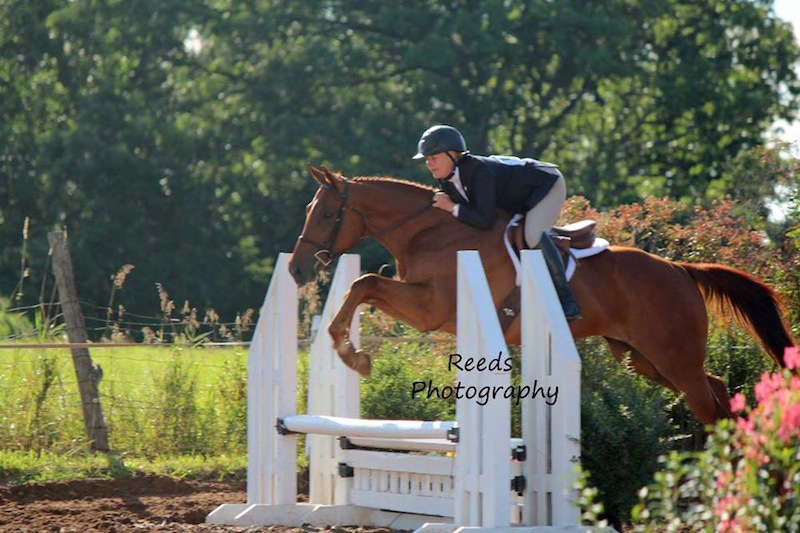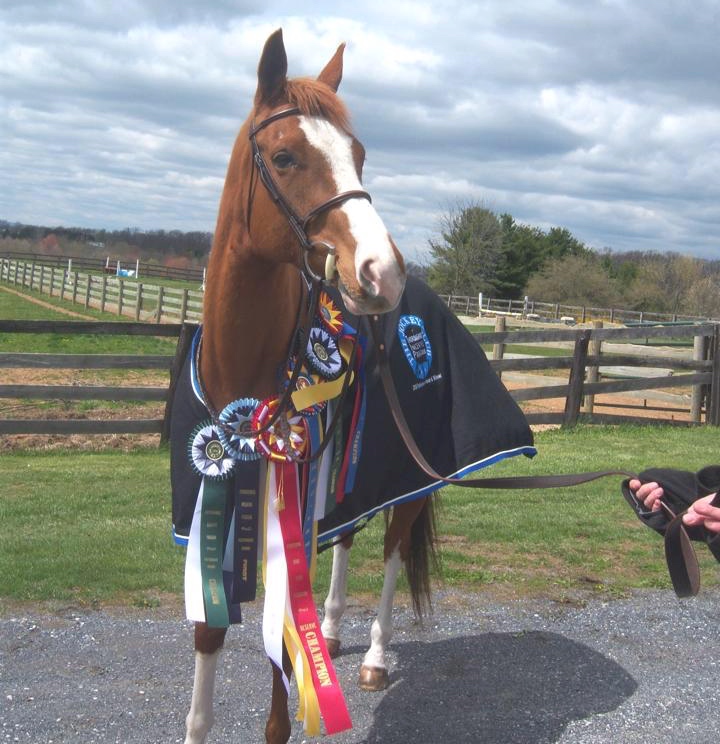
Innocent Til Proven is A circuit hunter/jumper

Innocent Til Proven re-trains in Calif.

Laura Hansen squinted against the California sun as the gleaming, perfectly balanced racehorse loaded onto the trailer that would whisk him off to Hollywood Park.

As she ran her experienced eye over the rippled muscles and squarely built form of Innocent Til Proven, a deeply pedigreed Thoroughbred, and half brother to Three Chimney’s stud Yes It’s True, she knew exactly what she saw.

This was no racehorse; this was a show horse.

“I would watch him go out to the track everyday to train, and he was just fantastic! He was laid back and steady, and he had the most wonderful demeanor, an incredible pedigree, and beautiful conformation,” says Hansen.

“My husband Scott (Hansen) said he wasn’t going to make it as a racehorse, and I couldn’t wait to train him: I saw the show horse in him.”

Both husband and wife have lived and breathed horses for their entire professional lives. Hansen’s husband Scott last worked as an assistant to famous trainer Bobby Frankel, while she exercised horses for him; and, before that, she galloped for other world-famous trainers, including Bob Baffert and Steve Asmussen.

Race name: Innocent Til Proven
Sire: Vindication
Dam: Clever Monique
Foal date: 2005
Shortly after the couple went to work for Gary Broad’s sun-splashed Thoroughbred facility, Oakmont Ranch, in the hilly California countryside, Laura Hansen latched onto the idea that Innocent Til Proven could be a different kind of star for the ranch.

When it became clear that this horse wasn’t born to run, the decision was made: they would not race him at all. His training, from 2008 through 2009, concluded, and after some time letting down from track training, he was redirected toward a job that proved to be his natural calling.

“Right from the start, he was super easy to transition,” Hansen says. “He was athletic and sound.”

Beginning with flatwork and dressage training to enhance his natural gifts, it wasn’t long before he was trotting confidently over poles, and later, small jumps courses.

If a horse could say, “Ahhhh, this is much more like it!” Innocent Til Proven did.

A happy, happy racehorse

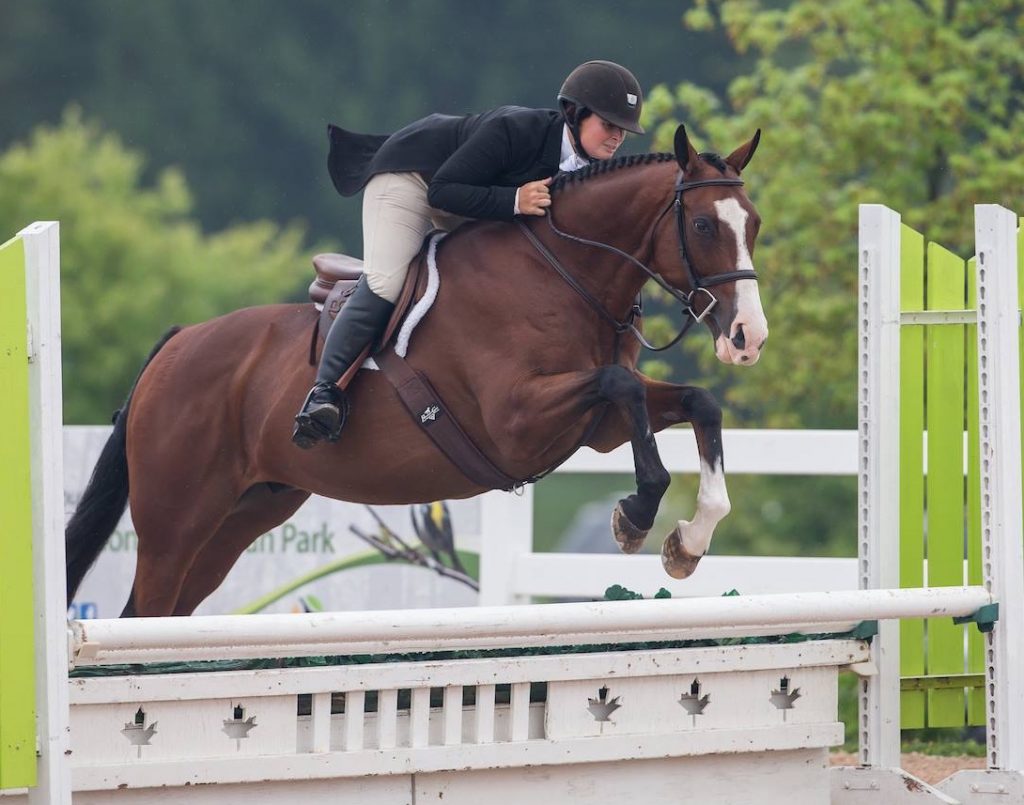
He entered his first horse show at the Del Mar Show Park in September 2010 and went around the ring, jumping every obstacle like a pro.

“You couldn’t pick him out from the Warmbloods!” she says. “At his first show, he showcased what a classy animal he is.

“And, when I tell people that he is a Thoroughbred off the track, their jaws drop!”

In no time, Innocent Til Proven started showing in the California A Circuit hunter/jumpers, proving again and again that a Thoroughbred who isn’t winning races at the track can excel in other disciplines, and against daunting competition.

“When it was decided that he wasn’t right for racing, I knew he’d be great at something,” Hansen says. “He was only six when we started jumping him, and every time, he did his very best. He jumped way high over fences; he’s a very scopey horse. And whatever you ask of this horse, he just seems to do.”

I'm pretty!

She adds, “Thoroughbreds are so athletic that they’re great at just about anything. They barrel race, they show jump, they event, they’re really not limited in their future careers.”

Owners and trainers, she notes, only need patience and imagination to nurture the natural gifts these animals possess; and thus, they tap into the talent that runs as deeply through them, as it did through their famous racing ancestors.

It may take a little time find to find the right career fit, but when the right fit is found, they’ll be stars in the end.

As Thoroughbreds always are.

Share

Young fan given son of Smarty Jones

In tears, Madison takes Smarty home

Ten-year-old Madison Scott was playing in the backyard of her Texas home when her father yelled for her to hurry and come inside; history was in the making.

The television in the Scott family’s living room was tuned to The Belmont Stakes, the third and final race of the legendary Triple Crown.

And on that June day in 2004, sports fans like her father, who didn’t usually follow horse racing, paused to watch chestnut colt Smarty Jones make a flying bid at winning what hadn’t been won in decades.

“My dad called me in to watch. He said a horse was going to win the Triple Crown, and that it was something to remember, and it was something to see,” Scott says.

In losing the great race that day, coming in second to Birdstone, Smarty Jones won something else; he captured the heart of a passionate girl whose young life would change indelibly after that race.

Mad for Smarty
Sire: Smarty Jones
Dam: Santaria
Foal date: Feb. 27, 2007
Career earnings: $115,619
Little Madison Scott started by writing letters. Then she penned songs, drew pictures and sent birthday cards—all addressed to the dazzling racehorse who resided at Three Chimneys Farm in Kentucky.

“By 2008, I was sending weekly emails to Three Chimneys Farm, and they always wrote back to me. They were amazing!” Scott says.

By the time she was 14, the fervent interest in all-things Smarty really grabbed hold. She subscribed to horseracing magazine The Blood-Horse—“I think I must have been one of their youngest subscribers!”— and she began to systematically follow the race careers of Smarty’s first crop of 88 foals.

She created a “virtual stable” that allowed her to keep track of all the races and standings of the superstar’s progeny, and every chance she got, she watched horseracing simulcasts.

Together, at last

And while her “non-horsey” parents watched from the sidelines, a bit bemused by their daughter’s zeal for the sport, admiration and respect for the child’s interest grew at Three Chimneys Farm, where, eventually, word of Scott’s passion for Smarty reached the horse’s owner, Patricia Chapman.

Chapman and Three Chimneys were so delighted by the girl’s passion that in July 2009 they flew her and her mother Lori Scott in for a visit.

For a week, they were ushered around Lexington, Ky., meeting everyone from Three Chimneys owner Robert Clay to Smarty Jones, and the racehorse’s owner.

“It was the most incredible experience of my life,” Scott says. “We’d drive down roads where, on either side, the greatest horses in the world were grazing. It was like a dream come true!”

Incredibly, while visiting the farm, Scott and her mother were asked to help name one of Smarty Jones’ colts.  “Robert Clay told us he wanted a name that would honor his father, and all of his fans, but also reflect back on me,” she says.

In short order, the moniker Mad for Smarty was given the two-year-old.

“My mother actually came up with the name. Mad reflects both me, it’s ‘Mad’ for Madison, and all of the fans who were crazy for Smarty Jones,” she says.

When the week came to a close and Scott and her mother flew back home to Texas, the young girl was bursting with happiness.

A beautiful beginning

She kept up a correspondence with Smarty’s owner, even visiting her once in Pennsylvania, and naturally, she paid extra close attention to Mad for Smarty.

“He did much better than the average racehorse,” she says with pride. “He ran in a graded stakes race and other stakes races and won over $100,000. He was definitely paying his way at the racetrack.”

Toward the end of September 2011, however, a ligament injury forced the retirement of Mad for Smarty. He returned home to Three Chimneys Farm to recuperate, and as he healed, Scott’s parents and Three Chimneys representatives began to talk.

Her parents were offered the opportunity to take Mad for Smarty, for free, and after weighing the financial ramifications of the decision, they enthusiastically agreed that the retired racehorse should live out his days with them, the family who named him.

On Jan. 7, an enormous horse trailer arrived at Bel Canto Farms in Wimberley, Texas to deliver Mad for Smarty to the young fan, who was uncharacteristically speechless that day.

When handed the lead rope to Mad for Smarty’s halter, words failed, she says in her new blog, madforsmarty.blogspot.com.

Madison gets to work

With tears in her eyes, and the materialization of her childhood dreams walking quietly beside her, Scott led her new horse for a 30 minute stroll before finally settling him into his new stall.

She will work hard for the privilege of horse ownership, taking a job feeding, grooming, and cleaning at her barn to defray costs. And will begin retraining Mad for Smarty in the new discipline of hunter/jumper this spring.

And she will pinch herself for several more weeks to come.

“I’m so grateful to the incredible people at Three Chimneys, and to my parents,” Scott says. “And I’m so proud to have this horse, and to know that my passion and dedication helped lead me to him.”

Share

Thoroughbreds ‘lift’ up autistic, disabled kids

Courtesy Abilities Conference

Joell Dunlap was struggling to make her instructions carry across the riding ring, above the din of a howling wind, to her young student who couldn’t quite grasp the concept of holding tighter to reins.

After several minutes of watching the child and horse flail, Dunlap strode across the riding ring, and in a loud, commanding voice, said, “I just really need you to hold your right rein!”

And the child, diagnosed with autism from an early age, and so sweet and eager to please, leaned over and whispered in her ear, “I’m trying.”

When she describes that moment, Dunlap’s eyes well up; her voice catches.

For it was on that very frustrating day at her riding academy in Half Moon Bay, Calif., that her life’s work came into sharper focus. The quick exchange with her determined young student underscored the full meaning of the name she had given her riding stable and federal nonprofit, The Square Peg Foundation.

In Dunlap’s world, “square pegs” are the people and horses who don’t fit neatly into a one-size-fits-all society. But, working together, horse and rider teams help one another in critical, life affirming ways.

Race name: My Cheatin’ Heart
Barn name: Hank
Sire: Broken Vow
Dam: Harmony and Peace
Foal date: 2004
“That moment with my student made me realize that nobody changed the world because they know how to post on the right diagonal, and it solidified for me what’s important” in the relationship between a horse and rider.

“There are so many things about riding that are valuable. Sometimes it’s the trust between the horse and rider that’s most important; sometimes it’s about helping the rider to feel powerful, or accomplished, or really elegant,” she says. For an autistic or special needs child, a ride on a horse can provide a different glimpse of the world, a broader perspective on life, she adds.

Dunlap began teaching special needs children to ride in 2001, while she maintained full-time work as a Thoroughbred exercise rider and trainer.

By 2004, when Square Peg Foundation was officially founded as a certified nonprofit, Dunlap began to delve more deeply into the connection between special needs students and the many off-track Thoroughbreds she worked to retrain and re-home.

“By the time I named my foundation Square Peg, I had begun to realize that when you try to force the fit, whether you’re trying to make a racehorse run who doesn’t want to, or you’re trying to make a special needs child sit still in a classroom, it doesn’t work,” she says.

Hank moves into the light

At her stable, it matters little how well a special-needs child can ride; what’s important is only that he or she derives some measure of positive stimulation from the experience.  And if a Thoroughbred can no longer run or be competitive in the world of professional racing, he can still be a star at Square Peg by virtue of his personality and heart.

“When an 1,100 pound animal is willing to respond to a child who is only capable of making a one-syllable command, you’ve got a pretty dynamic horse,” she says.

A favorite on her farm is Hank, a Thoroughbred who raced under the name My Cheatin’ Heart.

Hank recently served as an ambassador for The Square Peg Foundation and a therapeutic riding technique that helps a broad spectrum of autistic patients. And he did it in a big way.

Outfitted with rubber shoes and a western saddle, Hank strode bravely onto the slippery, concrete floor of the San Jose Convention Center to participate in the Abilities Conference last November.

Beneath bright, florescent lights, Hank walked before crowds of onlookers and was approached by wheelchair-bound people, as he demonstrated a therapeutic riding method for all levels of autistic children. The HorseBoy Method, which Rupert Isaacson created, offers kids the opportunity to sit atop a horse, while a skilled rider pilots the animal around at a walk, trot or canter.

Sitting in the lap of a coach, astride a powerful equine, the rhythmic movement stimulates the child’s brain, often eliciting humming and singing from the child.

Courtesy Abilities Conference

“All of a sudden, the ride is getting them to see outside of themselves, and to develop a new perspective on the world,” Dunlap says. “You can do this with a kid who doesn’t speak at all, or with a child who’s highly verbal, but needs to settle down.”

After Hank helped demonstrate the method, he wowed the audience with newly acquired skills of his own. On cue, Hank smiled, lifted his legs, and bowed for an audience that was charmed by a horse who hadn’t fit so neatly into life as a racehorse.

But, on this day, he shined as an ambassador for Thoroughbreds and The Square Peg Foundation.

He was a star of the three-day conference. Unfazed by the screeching feedback from a blaring sound system, the flashbulbs, or the slippery floor, the horse with dashing good looks smiled at the crowd from 20 paces and dealt with aplomb any distraction that came his way.

“When we first walked in, a crowd was playing wheelchair lacrosse,” Dunlap says. “We gave him a minute to take it in and he’d breath out and lean toward us. I was scared to death. But he just went with it.”

Hank, who is also a skilled polo player, has a level head in so many settings. He is often asked to deal with oncoming horses and mallet-wielding riders.

Greetings from Hank

“And if he is scared, he knows he can lean on humans to help him,” Dunlap says.

And Hank and other horses in the Square Peg Foundation program are only too willing to give joy to the very special people, like the little girl who tried so hard to hold the reins.

“Our Thoroughbreds exceeded our expectations that day at the San Jose Convention Center,” Dunlap says in a published report. “They smiled on cue, bowed for the crowd, and let numerous children with struggles such as blindness, cerebral palsy … and other developmental challenges, pet them.

“They were ambassadors of freedom and strength and power for people to whom life has dealt a different hand.”

Share