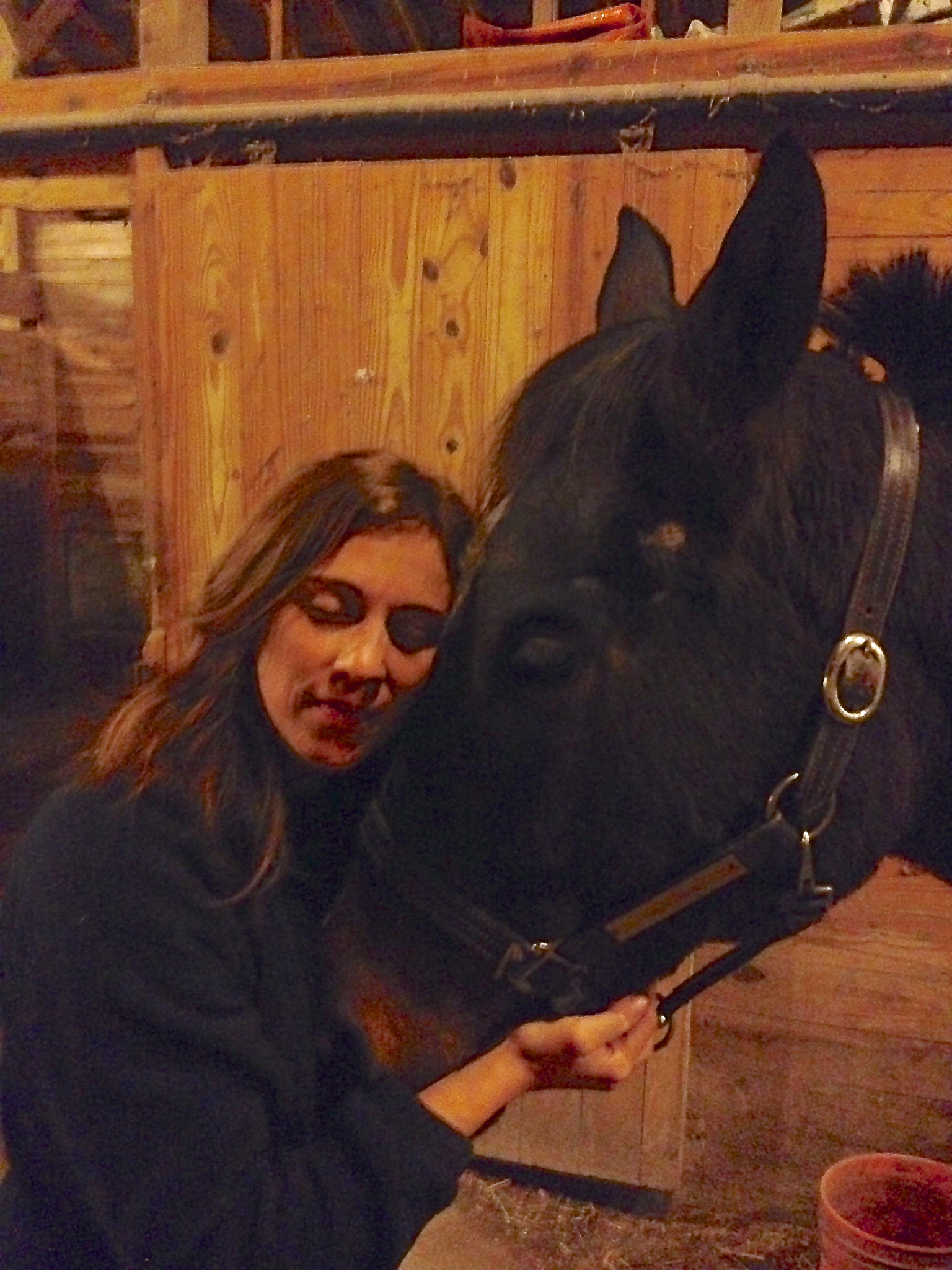
A mare slips away, her owner battles onward

Kalu's Heart was euthanized March 17 after suffering four serious impactions this past year. The sweet mare has inspired her owner to help other Thoroughbreds.

Kalu’s Heart was euthanized March 17 after suffering four serious impactions this past year. The sweet mare has inspired her owner to help other Thoroughbreds.

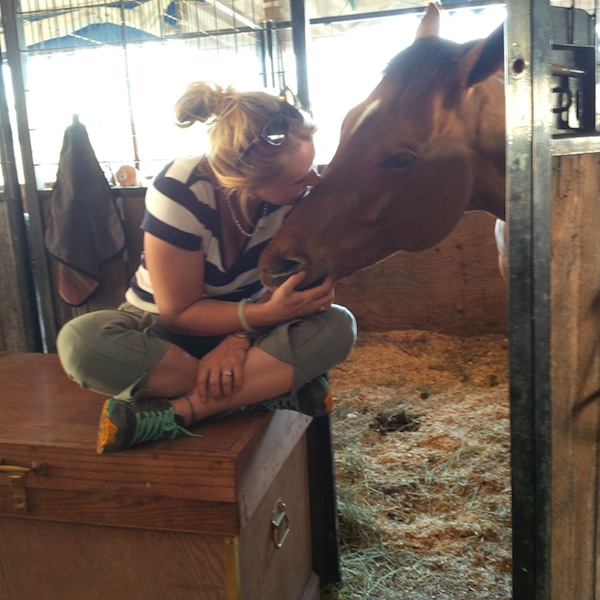
Gently sliding the downed animal’s head onto her lap, she looked into the sick mare’s eyes. Where she once saw a spark, she now saw surrender. And what she had feared for so long had finally come. And it was over.

After a year battling back from three bouts of impactions so severe they time and again threatened the 6-year-old mare’s life, Lisa Bernard’s horse seemed to plead for mercy.

“I felt like she said to me, ‘Let me go.’ ”

And just like that, Kalu’s Heart was humanely euthanized on March 17, leaving in her wake an indelible mark on the heart of her bereft owner.

“The story of Kalu is a complicated mess, about a horse’s will to live and the true courage and fight of a Thoroughbred,” Bernard says. “I wanted to tell her story in case it might help others going through something similar.”

Bernard first met Kalu’s Heart a year ago, in January.

The face of the dark, nearly black mare beckoned from an online advertisement. And soon after, around mid-January, Bernard purchased the ex-racehorse from owners who had run her at Mountaineer.

Kalu’s Heart
Sire: Kalu
Dam: High Hearts
Foal date: April 9, 2008
It was an uphill battle the moment she arrived.

In a blizzard that piled up snow at a rate of six inches every few hours, Kalu’s Heart rode in a van that inched its way to a country farm in West Virginia. “I worried the entire time because we were having a terrible snowstorm,” she says. “It ended up being 9 at night when she arrived, and as she stepped off the van, the snow was still coming down hard.”

Five days after she arrived, Kalu’s Heart fell ill with the biggest impaction Bernard’s vet had reportedly ever seen. “She spent a week-and-a-half in the hospital, there were two nights when we almost lost her,” she says.

At the worst of it, the new owner received a text at 1 a.m. from her vet at the Rappahannock Equine Clinic asking her to fill out euthanasia paperwork.

“It was a miracle she pulled through,” she says. “She went down in the clinic; her heart rate spiked up and she started turning purple.”

After an aggressive treatment, which included IVs, fluids, Banamine and tubing, the former beauty returned to her new owner looking strung out and thin. But she was better.
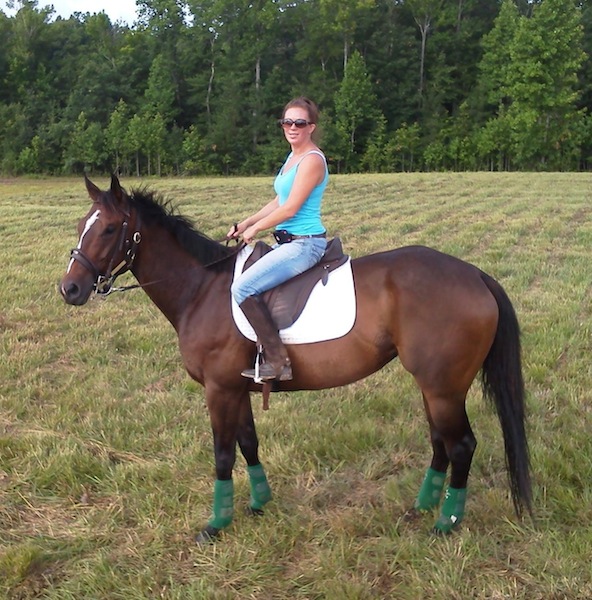
Kalu's Heart during her healthy months.

When Kalu’s Heart was healthy, she was invincible. She loved to learn and to please.

By March, Kalu’s Heart had made giant strides and was kicking up her heels and chasing other horses around the paddock.

“I knew then that it was time to ride her. I saddled her up for the first time and she was just so good,” Bernard says. “She was your typical racehorse, stiff as a board and not supple at all, but she was so willing, and proud that she puffed out her chest. It was like she was ready to rock on.”

From March to November, the pair enjoyed eight months of typical everyday pleasure, learning to jump, and relocating to a new facility and life in New York.

But on Nov. 15, another serious impaction was detected.

Back to the hospital they went, where the mare once again received round-the-clock care. “She ended up making it through, but she was never the same after that,” Bernard says.

“I started riding her again after a month, and she had some good days. She’d puff herself up with pride and seemed to stand two feet taller on those days. But on other days, her ears would flop sideways, and she just wasn’t the same horse.”

Three months later, the mare suffered her third impaction, and finally, on March 17, she went down with her fourth and final attack.
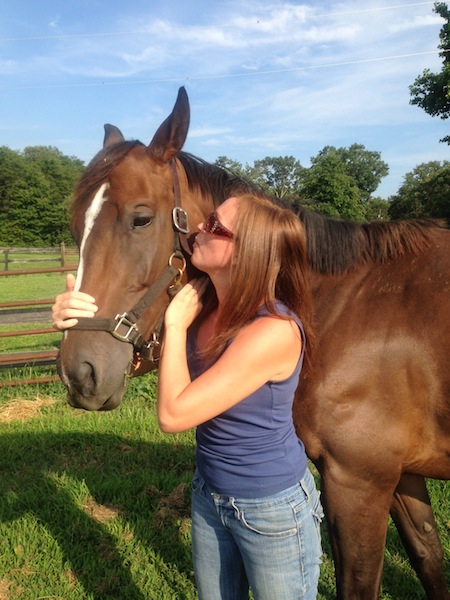
Bleached out from the sun, and worn out from illness, Kalu's Heart was a trooper to the end.

Bleached out from the sun, and worn out from illness, Kalu’s Heart was a trooper to the end.

Throughout the past year, Bernard did everything possible to protect her mare from illness: she wetted her hay, had her on a low-starch high-fiber diet, wetted her grain, treated her for ulcers, treated her with oil, heated her water, and gave her probiotics to support hind-gut problems. But in the end, her condition proved impossible.

When she said goodbye to her mare on March 17, she kept a few mementos; some nails from her horseshoes, her halter, which will be kept in a safe place. And, in the spirit of helping other Thoroughbreds, Bernard has started a small Thoroughbred re-training business, and named it with Kula’s initials.

The KH Equestrian Team, which bear’s Kula’s initials, will be dedicated to helping other OTTBs get a chance in the show ring.

“Kalu never got the shot she deserved in the show ring, but through her spirit, other horses can,” she says. “She lives on in my heart, soul.”

Blinded Everglades horse ribbons at HITS Ocala

Prodigioso, abandoned two years ago near the Florida Everglades—blind, burned, emaciated—ribboned at HITS Ocala last month.

Prodigioso, abandoned two years ago near the Florida Everglades—blind, burned, emaciated—ribboned at HITS Ocala last month. ESI Photography

Prodigioso, the burned and battered racehorse who was left to die on a desolate stretch of Florida Everglades, returned to the sunshine state this month to compete at the highly rated HITS Ocala series.

Glossy and confident, Prodigioso carried owner and rider Robin Hannah into the ribbons in every under-saddle class, and also won ribbons in all but two over-fences classes, she reports.

“He did extremely well, especially considering he was the greenest horse in the competition,” Hannah says. “People were amazed when I told them he’d just recently learned to do jumps, and here he was, at his first rated show, jumping 2-foot-6.”

More amazing still was that Prodigioso was there at all.

Two years earlier, the chestnut ex-racehorse was discovered by the SPCA on a lonely stretch of road that slices through sugarcane near the Everglades. Chained to a cinderblock, Prodigioso was freshly blinded in one eye, burned, emaciated, and terrified.

Trembling as he walked onto the rescue van, Prodigioso looked like a lost cause, but his rescuers refused to give up on him. He was taken to Thoroughbred charity Florida TRAC, and for eight months, he received tender loving care from Celia Scarlett and a team of volunteers.

Prodigioso
Sire: Southern Leader
Dam: Spirited Affair
Foal date: March 14, 2007
In an earlier interview with Off-TrackThoroughbreds.com, Scarlett recalls how it took Prodigioso six months to shed his nonstop fear. Please see earlier article here.

And when the poor fellow was ready to be offered for sale eight months after his rescue, few wanted a partially blind horse; but the miracles kept on coming.

Adopted by Niagara, Canada horseman Marilyn Lee-Hannah and her equestrian daughter Robin Hannah, the pair looked past his slightly malformed blind eye, , and decided to shout his story from the rooftops.

In addition to the interview with Off-TrackThoroughbreds.com, they granted interviews to a local Canadian television station, and they recounted his story at the Thoroughbreds Makeover National Symposium at Pimlico last year. He was given a hero’s welcome after he trotted onto the fabled racetrack and performed alongside Thoroughbreds who had not been through nearly so much. (Please see that story here).

Prodigioso and Hannah share a quiet moment at during their three-week stay at HITS Ocala

Prodigioso and Hannah share a quiet moment at during their three-week stay at HITS Ocala

At the Pimlico show, Prodigioso stood out because of his story.

At HITS Ocala, Prodigioso stood out for his showing acumen.

“Nobody really knew his other story,” Hannah says. “A few people noticed his eye and asked about it. But the reason he stood out was because he was perfect.”

He didn’t turn a hair when he walked into the ring—nothing fazed him. “He just went right in, jumped every jump—it was kind of shocking, but then again, maybe not, because he is such an awesome horse.”

Prodigioso competed in classes with 10 to 12 other Thoroughbreds, very high-rated show animals who had more experience under their belts, she says, noting that Prodigioso still managed to be in the top four finishers in every under-saddle show, and he ribboned in all but two over-fences.

Prodigioso just returned home to Canada after three weeks at HITS. He will rest up for the upcoming Trillion shows, and if all goes well, will be entered in the A Circuit Baby Greens this summer.

To think that a horse left for dead, scarred and battered, could embrace people again, work for them, shine for them, is a thing that “humbles” Hannah. “It’s shameful what we do to them, and they still love us,” she says in her earlier interview, adding, “I always say that this is the most special horse I’ve ever had.”

A Texas homebred lands with family in Ky

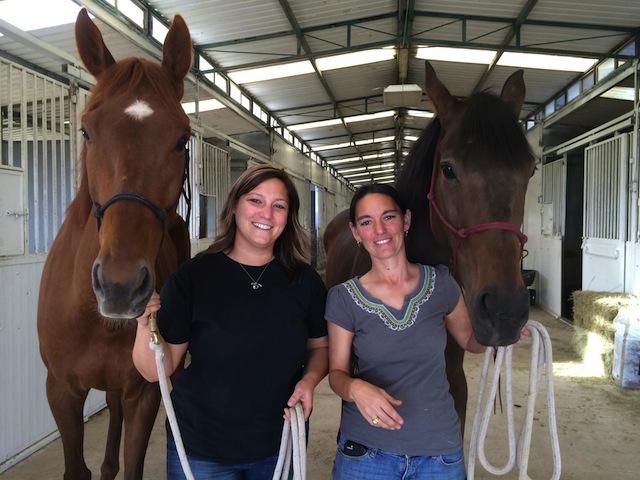
Apositively, on left, is leaving Texas to take up residence at Wild Aire Farm in Kentucky, among family.

Apositively, on left, is leaving Texas to take up residence at Wild Aire Farm in Kentucky, among family. He is held by Lisa Bradford. Also pictured is Jen Frey.

Finding family connections can bring the sweetest surprise. As Ann Banks learned one day while absently researching the pedigree of a nondescript T’bred, and suddenly coming face to face with her own storied past.

There in the historic annals of the Dam’s side of Texas racehorse Absotively was Bank’s extended family of old-time horsemen, who helped establish great Thoroughbred bloodlines.

“The whole female side of this horse’s family are horses bred by my extended family,” Banks says. “It’s just unbelievably cool!”

Home-breds brought into this world by the family of Hal Price Headley, founder of Keeneland, and by his daughter (and Banks’ former mother-law) Patrica Headley Green go back for generations. And just seeing their names again— Sing Sing, Fuchsia Filch, Regal Purple— excited her so much that the lady who says she needs another horse “like a hole in the head” was unable to resist purchasing this one, who carried in him the greatness of her past, and of horse racing’s past.

Absotively
Sire: Silent Picture
Dam: Truth by Ruth
Foal date: April 10, 2010
“I usually have a problem with people bragging about breeding. But then I find this horse, and I’m saying to myself, ‘oh my God! Oh my God!’—There are just generations and generations of homebred mares, which is the way great farms like Calumet and the Phipps family used to do it.”

And this is how one humble Texas-bred, entirely lacking in shine and track performance, came to find a new home in Kentucky this month.

Absotively was picked up from Sam Houston, loaded on a trailer, and with the help of CANTER-Texas, Banks and the horse’s former owner struck a deal.

On March 15, Banks purchased Absotively, and is being delivered this week to Wild Aire Farm.

“I’m so excited. I haven’t been this excited about a horse in a long, long time,” she says. “He’s coming here at the perfect time, because the grass is just beginning to grow.”

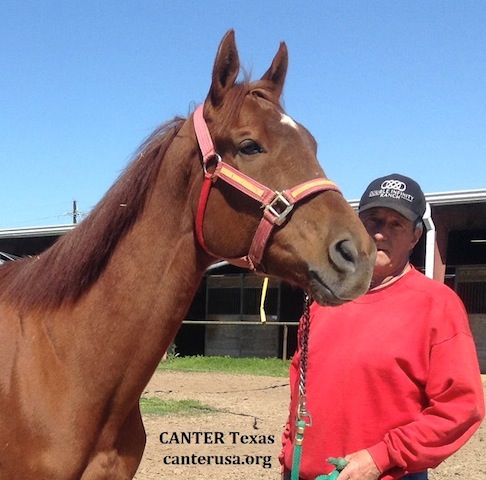
The face that galvanized a Kentucky horseman to take action.

The face that galvanized a Kentucky horseman to take action.

When he arrives, a farrier and Banks’ veterinarian will immediately tend to the 4-year-old, she says. Once his needs are assessed, and he is given time to chill out and enjoy the Kentucky bluegrass, Banks will enlist the help of her go-to trainer Lauren Lambert. “He will eventually end up Eventing,” Banks says.

While Banks waits for the trailer to pull up her driveway bearing all the history, of horses and of her family, she muses about the strange business of life.

“I don’t know what made me look up his pedigree,” she says. “I keep track of horses who turn up looking for homes, I always like to keep an eye out in case one of my former racehorses is in a bad place. I knew I didn’t have any Texas-breds, but I looked him up anyway.”

And when he comes home to Kentucky, the cradle of horse racing, Banks plans to make it her mission to see that from here on out, Absotively lives the life he so richly deserves.

“Every horse in his lineage is a ‘wow,’ ” Banks says. “It’s unusual to find a horse that has 10 generations of homebreds!”